 Share on bsky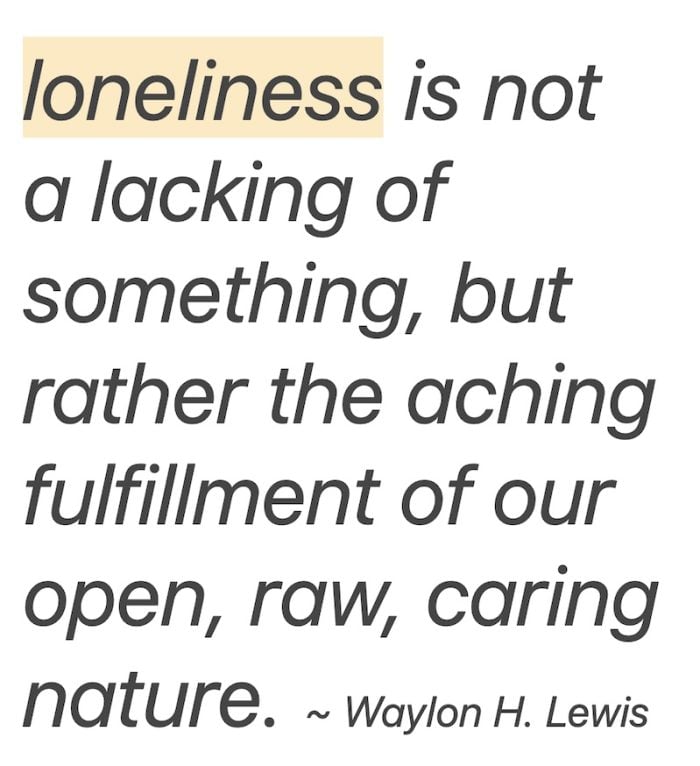
Loneliness is a hot topic, these days.
An entire generation of screentime-besotted young men, apparently, are turning toxic and weird and woman-hating because they’re running away from it. Loneliness is seen as weak.
But hanging in there with loneliness is hard. Really hard. Hanging in there with loneliness is what’s tough. It’s running from loneliness that is small, that’s cowardly.
Even if you talk about how “loneliness isn’t bad” with someone “normal,” they’ll inevitably correct you:
“Oh you mean ‘alone,’ not ‘lonely,'”
they’ll say, as if they’re a French philosopher dropping wisdom from a cafe dans Saint-Germain-des-Prés.
We can’t even say the damn word, let alone admit that most shame-faced of failings:
“I’m lonely.”
So let’s finally talk about loneliness—not aloneness, where you’re okay with how you feel—but about loneliness, where it’s hard and it hurts and it feels as if your heart is naked, raw, exposed to the slightest cool breeze. The kind of lonely that feels contagious, as if everyone can see or smell it in you and is avoiding you because of it.
Loneliness results from the failure of our ego to con our reality, and ourselves. It’s an opening. Genuine sadness is better than fake happiness because it opens up the possibility of genuine joy, and of compassion for others going through the same thing.
I’ve always been a bit lonely, though I’ve always known many people, and had many dear friends, and a wonderful mama. Despite that, I’ve long lapsed into intense loneliness.
Luckily, I had the Buddhist teachings as a reference point, and they emphasize that loneliness isn’t a problem. In fact, as a gentleman from another tradition entirely says:
There’s a crack,
a crack in everything,
that’s how the light gets in
~ Leonard Cohen.
Loneliness, Pema Chodron reminds us, is in itself the feeling that is bodhicitta, or our fundamentally awake, good, aok human nature or “seed of awake.” The noble, peaceful warrior, Trungpa Rinpoche reminds us, is always broken hearted. Always. Ouch.
Loneliness is, in the Buddhist tradition, considered a good thing. It puts us on the path of becoming an awake, caring, kind Buddha. But even before that, a good thing in and of itself. Because it means we’re open.
Finally.
Buddhism isn’t big on philosophy. This isn’t just a fun opinion. It can be experienced. In fact, it’s the gateway to empathy, that most transformative and powerful of human emotions. Loneliness becomes empathy, and empathy is the glue, or fabric, or webbing between human beings that creates peace on earth.
So yeah, it’s kind of a big deal.
~
My first love was a girl named Susannah. We met when we were in high school, and had a glorious, wonderful, tragic, sweet year-and-a-half together.
After we broke up (all my fault), I missed her every day, for years.
Every single day.
It helped somewhat that I’d been raised in the Buddhist tradition—I’m sure other religious and agnostic childhoods would bear other helpful fruit, but what I know is my own experience. Reading a teaching on loneliness by Pema Chodron (an American Buddhist nun who was an early student of Chogyam Trungpa and now studies with Dzigar Kongtrul Rinpoche), I was amazed that in the Buddhist view the feeling of loneliness is identified as the feeling of Buddha Nature itself.
In other words,
loneliness is not a lacking of something, but rather the aching fulfillment of our open, raw, caring nature
I remember thinking about this as I left a cheerfully crowded banquet, looking up at Marpa Point (a big mountain) glowing under the moon up at Rocky Mountain Dharma Center (renamed Rocky Mountain Shambhala Center, then Shambhala Mountain Center, now Drala Mountain Center), in 1992, and my friend Jenny comforting me. I missed Susannah so badly that night, the stars and moon and silhouetted mountains seemed to prick little holes in my silly red heart.
Other Buddhist texts remind us that when we fall in love with our teacher, or the Dharma, it is only a recognition of our own enlightened nature in others, or externally. We have only to realize, in such open, empty moments, that the love that we seek is present, now.
“An analogy for Bodhicitta is the rawness of a broken heart. Sometimes this broken heart gives birth to anxiety and panic, sometimes to anger, resentment and blame. But under the hardness of that armor there is the tenderness of genuine sadness.
This continual ache of the heart is a blessing that when accepted fully can be shared with all.”
~ Pema Chodron, The Places That Scare You.
~
Holidays have a way of highlighting how lonely we already are.
I remember, one year, I was popular and well known and my business was a sponsor of a Valentine’s Ball for women’s health.
I attended alone.
There were hundreds of gorgeous in-and-out people going to the St. Julien Hotel, friends partying at a favorite hangout, and all the other restaurants and bars were full of sweet lovers and banded-together loners alike.
The “shadow” side of St. Valentine’s Day, is something like the “shadow” on Christmas, that other warm and bright holy-day all about togetherness. For more folks than not find themselves alone.
Similarly, every winter, I’d attend the Nutcracker, with family friends and a holidate. I attended, with a few misses, for the last 20 years. I’m not sure why I never get tired of it, why it only grows on me, why the music seems perfect, why the cute children (clumsy, adorable) and the professionals (impressive, refined) in the ballet alike add to the wonder of it.
I love the Holidays.
I’m Buddhist, so I enjoy the Jewish traditions along with the Christian traditions along with the crafts fairs and whatever else comes up. Especially if it’s snowy, the cultural traditions only seem to underline the simple, quieting, slowness and familial cheer of this time of year—even for those who, like me for so many years, are single and without family.
Of course, the cheer can also highlight a sense of loneliness, of missing out. For years, I wondered:
“Why am I single? Why am I alone? For all my work, why am I not actually helping this world of ours all that much? Why am I the 6th man on most friendship teams?”
Loneliness is a foundational thing. We all feel it, whether we’re alone or surrounded by family. Loneliness may hurt, but it isn’t bad. It just is. What we do with it, however, flows into one of two paths. We can solidify it into blame—of oneself, into poor-me-ism; and of other, into resentment.
Or…it can manifest in raw heart, in empathy, in caring, in sweet sad joy. And that, for me, is the essence of the sweetness of this season—not some saccharine-thin forced-happiness.
And whether we’re ashamed of that loneliness, or fine with it, we are choicelessly reminded that loneliness, uncovered, is at the heart of being a true, full human being. At least, that’s what I was taught.
~
Loneliness is not a thing to be conquered. It’s a thing to make friends with—then you’ll be with your best friend wherever you go—your sweet red heart.
“An analogy for Bodhicitta [Buddha heart, seed of awakening of goodness within all of us] is the rawness of a broken heart. Sometimes this broken heart gives birth to anxiety and panic, sometimes to anger, resentment and blame. But under the hardness of that armour there is the tenderness of genuine sadness.
This continual ache of the heart is a blessing that when accepted fully can be shared with all.”
When in doubt, read Pema Chodron.
This article may be included as a chapter in Waylon’s forthcoming, tentatively-titled “Self-Help is Bad for You.”

author: Waylon H. Lewis
Image: Author's Own
Editor: Molly Murphy

Read 0 comments and reply