0
 Share on bsky
View this post on Instagram
Emotions are our motivators and drive everything in life.
They are physiological responses within the body to our perceived stimulus.
Emotions are a combination of external information and our internal biological cues, which are weighed against past experiences and knowledge. Put simply, they’re a wildly intricate game of prediction and analysis.
Emotions are signals of information—they reflect our state of mind and can serve as a warning, alerting us to when we have an unhelpful belief pattern or a negative automatic response in our nervous system.
Some emotions become stored within the body from intense or repetitive experiences and movements, stress, and trauma. Emotions are a chemically generated response in the body and can end up manifesting into physical sensations, pain, or repeated behaviors. When we go through something emotional, and the chemical stress response is not completely discharged, this is when they become stuck.
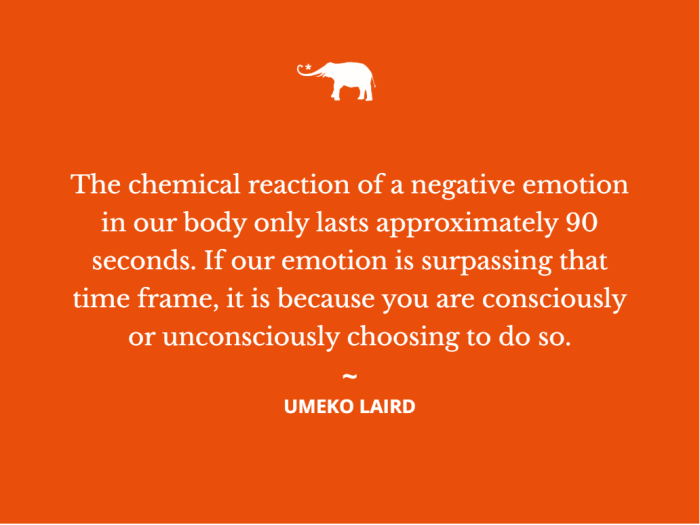
This may be a little hard to hear, but fascinatingly, when we experience an emotion like sadness or anger, the chemical reaction in the body and brain actually only lasts approximately 90 seconds.
So if our emotion is surpassing that time frame, it is because we are choosing to do so—either consciously through rumination, or unconsciously from our underlying beliefs that create automatic negative thought patterns.
The first step in learning how to process our emotions is to begin paying attention to what it is we’re actually feeling: name the emotion. When we realize which feeling we’re experiencing, we have to be careful not to get caught up associating the feeling as ourselves—I am angry, I am sad—this makes it feel more permanent and intense. If we switch our language to—I feel angry, I feel sad—this alone can help relieve some of the weight.
Next, we want to notice where in our body we’re feeling the emotion. What does it feel like? Does it have a color, a texture, or a temperature? Observe the sensation with curiosity. As we begin to identify different feelings, mapping our emotions can be a wonderful exercise to practice.
Draw or print a simple outline of a human figure (something similar to the figure on a restroom sign) and use colored markers to indicate where you sense different emotions. Creating a separate figure for each emotion works best.
Lastly, once we’re able to identify the feeling and locate where in the body we’re experiencing it, we can start identifying what the sensations are that lead up to the more intense emotional reaction. When we have enough self-awareness to identify these preceding sensations, we can use healthy strategies to lessen, or even prevent our emotional reaction.
Often, we avoid our feelings, not allowing them to be fully noticed or expressed. When we take the time to become familiar with our different feelings and where they show up in our bodies, it can make them much less scary. We can begin to recognize that emotions are only temporary responses that are asking to be acknowledged so they can be released.
Emotional healing comes from recognition and expression, not suppression. Learning tools and techniques to release and emotionally regulate can move us from pain to freedom, physically and mentally. Imagine a life where we aren’t ruled by emotions, but rather, able to easily handle, understand, process, and release all of our experiences. It takes time, consistency, and patience, but it is absolutely achievable.
~


This account does not have permission to comment on Elephant Journal.
Contact support with questions.