| ||||||||||||||||||||||||||||||||||||||||||||||||||||||||||||

*Editor’s Note: Elephant Journal articles represent the personal views of the authors, and can not possibly reflect Elephant Journal as a whole. Disagree with an Op-Ed or opinion? We’re happy to share your experience here.
~
The Red Zone speaks to the time period between when the Fall Semester of college begins and Thanksgiving Break as this is the period that over 50 percent of all sexual assaults on campus occur. This is also the period when the case with allegations against the Cornell 7 occurred as well. But it’s not something I ever heard about until it was too late. Though I have wondered in retrospect if there is anything I would have done differently or that I could have done in order to change the outcome.
I have raised both my daughters to be fearless young women. To advocate for themselves, to hold boundaries and call out unhealthy or toxic behavior. But I’ve also taught them the balance between needing to be mindful of what it means to be a woman and also not taking on the work of men as their own.
And still, my own daughter began a relationship with a young man who seemed to align with everything she’d been taught and everything she’d wanted for herself. So much so that she even brought him home to meet her family. Like everything, it all seemed to be going so well, until suddenly it wasn’t and it all began to unravel so quickly.
As women we are taught to protect ourselves. To watch our surroundings. To hold our keys in our hands, to carry personal alarms, cover our drinks, be mindful of how much we drink or what we wear. However, what we’re seldom taught is that it’s not the stranger lurking in the darkened alley we have to fear but the one who we’ve already let inside our lives.
The sad and disturbing fact is that 80 to 90 percent of all sexual assault or physical attacks that happen to women do so at the hands of someone we know. This means that it’s the boyfriends, the husbands, the friends, the brothers who are already in our lives who cause the greatest harm and not the ones we’ve traditionally been taught to fear.
For my daughter, had I known about the Red Zone, I may have been more cautious. I might have asked more questions or been more skeptical of the relationship. I may have been less concerned about supporting her and more focused on making sure that this relationship was truly supporting her being healthy and having the freshman year she worked so hard for.
But in many ways, I also know that likely nothing I did could have affected the outcome.
Perhaps that is part of the problem, not just in the Red Zone but collectively. The work of ending sexual assaults and violence against women isn’t on women. We are already doing enough. We are already training generations on how to protect ourselves from unwanted attention, acts, or violence. But as a woman and a mother, I have to start wondering when we’re going to start training men not to do those horrific acts. When are we going to see that it’s not about a woman doing more, but collectively teaching men to be better.
My daughter did all the right things. She never went anywhere alone. She watched what she drank and remained aware of her surroundings. She took her time in getting to know this young man and even had him meet her family. Yet, underneath all of what she did right, she’s still learning that it’s not her responsibility for what went wrong.
While I talked with her before writing this, after all it’s her story, we also spoke about how there wasn’t anything she could have done differently. Just as there wasn’t anything I could have done differently, nor that Jane Doe could have done differently as part of the Cornell 7 case. Because women can do all the right things, take all the precautions, and still end up being a statistic.
And perhaps this is the true lesson of the Red Zone.
It’s not necessarily about following the list of rules that we have to abide by as women, but in taking an honest look at the men closest to us and holding them to the same standards that we’ve held ourselves to. It’s not enough for the men who shout “Not all men” or those who use female friends as evidence for their safety. Men have to hold other men accountable. And while this begins far before anyone reaches the Red Zone, it is part of the collective work that society is being called to do. I am tired of teaching my daughters how not to get raped. I am exhausted by trying to explain to them that how men react to them isn’t theirs to hold. I am utterly spent from holding the weight that was never mine nor any woman’s to hold.
Because we should be able to dress however we like. We should be able to drink, to go for walks in the moonlight by ourselves, but mostly, we should be able to trust that the men in our lives won’t take advantage of us given the chance.
While I had always hoped that my daughters wouldn’t be like me as they got older, I mostly hoped that they wouldn’t have to go through the harassment, assaults, and abuse that I have had to go through with men. Yet, for one of them that is already a lost hope. We are already a house of statistics that before the age of 18, two of the three of us have been victimized by men.
This isn’t an issue of women at all, but of how society has failed so dramatically that somehow this is what we’re passing down to our daughters.
I want to live in a world where I can tell my daughter she looks beautiful and not worry about how a man will interpret her outfit, regardless of her age.
I want to hear all about a first date and not ask if he respected her boundaries.
I want to be able to focus on enjoying this life with my daughters instead of how to keep all of us safe.
Because the Red Zone and the epidemic of violence against women only exists because of men and not what we chose to drink, wear, or even who we date.
~
View this post on Instagram
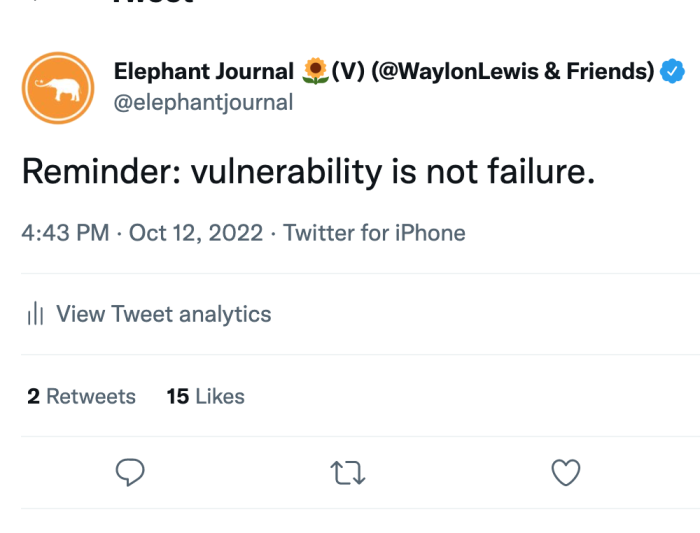
Vulnerability is not weakness. It’s true strength—if it’s genuine, not mere emotionalism.
Usually when something difficult, awful, scary, cold, selfish, cruel, happens in our life our ego says,
“Push it away. Ignore it. Be quiet about it. Get away from it. Cling to pleasure.”
When really what we need is vulnerability and bravery and healing. ~ @waylonlewis

Where is that?
I don’t know. But I am here.
In the backyard where I grew up, though it looks different now. Gardens full of strawberries, bees, and colored lights. Wind chimes that sound like a memory I never quite understood.
A whisper of okay-ness, blown into a Wednesday morning as I stare down uncertainty.
Did I make the wrong decision?
How will I fit everything in my car? Will my tires blow out in the desert? I can’t wait to see Joshua trees! Will my dog be okay?
Ten days of intensive. Maybe, strangely, a reprieve from the constant planning of my ever-swirling mind.
Will my couch make it to Boulder in time? Should I have chosen Boulder? Did I decide too soon? Where will my practicum be? Can I continue to travel? How will I make money?
Is my dog okay?
Did I make the right decision?
I can’t wait to drive. I made a playlist called “Crossing Over.”
Over what?
I don’t know.
Not knowing feels more certain than knowing.
West Texas nothingness merging into orange plateaus, rusty canyons, colonies of cacti, transforming into mountain pines and then the desert…
Mystery unfolded into earth.
How I love the desert.
But maybe not this time of year.
And the Pacific Ocean.
I have missed you.
I want to settle down.
I am terrified to settle.
Is my dog okay?
Did I make the right choice?
Who will watch him in November?
This mind on repeat like a pinball machine, addicted to the thrill of bouncing, pinging, ricocheting.
Should I have pulled harder?
Stopped playing?
Put more quarters in?
And then I look at the pink crepe myrtles in my mother’s garden.
They weren’t here when I was growing up.
Now they mix shade and beauty that falls like colored snow.
There are signs of grandkids everywhere. A rainbow ladder hanging from a tree that I bought for my niece. We’ve climbed it together many times now.
I used to love climbing trees.
Life moves on and on and on.
What is true?
It is still hot.
Climate crisis is here.
Old structures are crumbling.
Tomorrow will be Thursday.
Is time even real?
My dog is panting. In this moment, he is okay. Sleeping beside me. I can see the rhythm of his breath.
Now he is off to chase lizards.
Tomorrow we will drive.
Toward Southern California. Then Boulder. Then Turkey. Then Kenya.
I hope to settle after that.
But there is Thailand and Sundance and so many more maybes.
And none of those maybes are happening right now.
Right now there is the sound of running water.
There are wind chimes.
There are bees and strawberries and pink crepe myrtles.
And mosquitoes I wish were not here.
I have been traveling for a while now. Living on the road—out of suitcases. Upstate New York to Washington D.C. to Greece to West Virginia to Texas to Boulder to Guatemala. Now Southern California, back to Boulder, then Turkey, then Kenya.
It sounds romantic.
And sometimes it is.
I am grateful.
But somewhere in all this planning, I keep forgetting…
The planning was never real.
The living is.
The characters. The relationships. The conversations I never expected to have. The people I didn’t know I would fall in love with. The crying laughter. The laughter crying. The grief. My heart broken open. The oceans and mountains and long drives alone that never feel lonely.
Poet David Whyte says, “What you can plan is too small for you to live. What you can live wholeheartedly will make plans enough for the vitality hidden in your sleep.”
Maybe that is what I am trying to remember.
It’s funny…the control I think I have.
Choosing can narrow down freedom, and yet freedom can never be contained by choice.
I want to know I got it right.
But I don’t think life is something we get right.
It was born to live.
May it be so.
~
author: Angela Meyer
Image: Author's own
Editor: Nicole Cameron

 Share on bsky
Read 1 comment and reply