0
 Share on bsky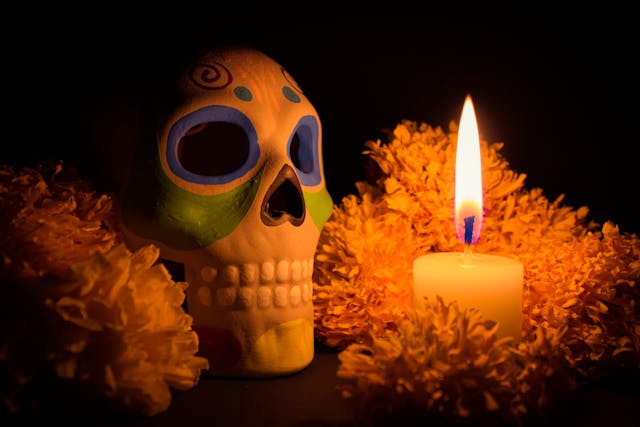
As the days grow shorter and leaves crackle underfoot, we are gently reminded of a truth many prefer to avoid: all living things die.
In autumn, the vibrancy of summer fades, trees release their leaves, and plant matter begins to decay on its way back to the soil.
Nature models what our modern world so often denies: that all living things follow the same cycle, from birth to bloom, from bloom to decay, from decay to birth. In fact, from the moment we arrive in this world we are moving toward our end.
This seasonal awareness of life, death, and transformation is not new. Long before Halloween became a night of tots in costumes collecting piles of candy, ancient people marked this turning point in the year with reverence and ritual. It was a time when humans lived in deep connection with nature, attuned to her rhythms, and their inner lives reflected that sacred flow.
Among the Celts, the festival of Samhain (pronounced SAH-win) honored the thinning of the veil between the worlds of the living and the dead. Samhain was celebrated at the moment of transition, in-between summer and winter. It was neither fully light nor fully dark, neither life nor death, but a mystical in-between.
It was believed that the boundaries between worlds blurred and that the spirits of the dead could walk among the living. Ancestors and benevolent spirits were honored, although trouble making spirits were also believed to roam, playing tricks on unsuspecting victims. Some people even played tricks themselves, blaming their antics on mischievous spirits.
Bonfires were lit and costumes were worn to confuse or repel those less-than-friendly wandering spirits. There was an air of reverence, not fear, and death was not treated as taboo or terrifying but as a part of the larger cycle of life.
While our modern Halloween traditions do trace their roots back to the ancient Celtic festival of Samhain, the holiday has taken many twists and turns over the centuries. Beginning in the early Middle Ages, as Christianity spread through pagan regions, Samhain was gradually overlayed with Christian symbolism (All Saints Day, All Soul’s Day, and All Hallow’s Eve) reframing the old seasonal rites with new religious meaning.
It was also the Church that encouraged the practice of “souling,” a kind of early trick-or-treating in which the poor would go door to door offering prayers for the dead, assisting them on their way to heaven in exchange for soul cakes (small round biscuits). This shifted the focus away from folk spirituality and toward a heaven-and-hell framework, leaving behind the cyclical view of life and death.
In the 19th and 20th centuries, Halloween was further domesticated under Victorian and middle class values, which aimed to suppress any unruly mischief or spiritual wildness that lingered from earlier pagan roots. The focus of the holiday shifted toward families and children, sweets, and more sanitized expressions of the festivities. Candy companies, costume manufacturers, and greeting card companies hopped on board, turning Halloween into a highly profitable annual event and reinforcing consumption over contemplation.
Later, Hollywood and pop culture added layers of gore, horror, and hellish imagery (elements that were never part of the original pagan celebration). As a result, we now tend to ignore death entirely or depict it as grotesque and terrifying, distancing ourselves further from the natural rhythm of life and death that ancient traditions once honored and embraced.
The tone of reverence, wonder, and respect once central to autumn rituals has largely been forgotten.
In my own home, I’ve tried to create a different kind of Halloween, a return to something more meaningful.
Each year my daughter and I create an altar to our dead: we lay out their photos, favorite foods, personal items, flowers, and candles. It’s an opportunity to normalize the topic of death, to approach it within a container of love, memory, and connection rather than awkward avoidance, fear, or gore. The ritual naturally leads to me share stories with my daughter about her late relatives that she might otherwise never hear.
And yes, we still dress up. I’m not trying to be a Halloween killjoy. I genuinely love the creative spirit of the holiday—the costumes, the play, and the sense of community. My daughter is a musician, and for the past eight years she has dressed up as Willie Nelson, Dolly Parton, Elton John, David Bowie, Prince, Cindy Lauper, Johnny Cash, and Lester Flatt (each year learning one of their songs). Dressing up for Halloween has brought us so much joy and laughter.
I believe we can enjoy the fun and fantasy and bring more intentionality to how and why we mark these sacred turning points in the year. These hallowed moments invite us to pause, reflect, and reconnect with the deeper truths of what it means to be here, to be alive, and to be human. Our holidays remind us of what matters most, while passing those values on to the generations to come.
So this year, amidst the fallen leaves, costumes, and pumpkins, I invite you to carve out a small space for remembrance. Light a candle. Tell a story. Remember someone special. Create your own ritual, however simple, to honor the cycle of life and death.
Perhaps, we can turn Halloween into more than a sugar rush or a scream-fest by leaning into deeper themes of remembrance, connection, mortality, and playful creativity. Perhaps we can teach our children that death is not a horror, but a magnificent mystery. Maybe together we can reflect on the long, rich lineage from which we come and the human story still unfolding, beyond any single life. Maybe this Halloween we can take a small step toward returning the holy to our holidays.
Ideas for a more meaningful Halloween:
Build an Ancestor Altar: Set up a space with photos, candles, food, and keepsakes from those who have passed.
Dress as the Dead: Instead of dressing up as a random character or creature, choose someone famous who has passed on (a historical figure, artist, or cultural icon) and learn about their life.
Cook a Family Recipe: Make a dish your ancestors might have enjoyed. Share stories at the table.
Take a Nature Walk: Observe the dying leaves, the withering plant matter, the crisp, cooling air. Take notice of nature’s reminders of the cycle of life.
Community Remembrance: Encourage others to share memories of their departed loved ones.
Explore Global Traditions: Learn how cultures around the world (past and present) have marked the turning of the season with their own unique autumn rituals and celebrations.
~


This account does not have permission to comment on Elephant Journal.
Contact support with questions.