|
|
|
|
|
I believe God wants you to know ... ... that hope has
always been your greatest strength, and it continues
to be today. When
others are about to give up and give in, you've been the one to
stand firm and strong. Good for you--and good for
everyone else around you! Why am I telling
you this? Because someone near you needs a bit of
hope today. You won't be able to miss who this is.
So thanks, ahead of time, for helping that
soul... |
|
|
|
|
|
|

We don’t wake up and decide, “Hey, today I’m going to feel anxious, irritable, heavy, or overwhelmed.” On those mornings, the feeling is already there before we’ve even opened our eyes.
The tightness in our chest.
The buzzing in our head.
The nervous flutter in our stomach as we think about the day ahead.
We tend to call that a “bad mood.” But psychologically and biologically, it’s something much more precise. It’s a chemical state.
It’s the stress hormones: cortisol and adrenaline.
Our nervous system is always running one of two broad programs. One is designed for threat and survival. The other is designed for safety and regulation. Most of us move between them many times a day without realizing it.
When stress chemistry is running the show, cortisol and adrenaline are doing exactly what they were built to do. They sharpen our attention. They tighten our muscles. They prepare us to deal with something that feels dangerous, uncertain, or overwhelming.
This system kept our ancestors alive. The problem is that modern life triggers it constantly.
An email from a boss.
A tense conversation.
A memory we didn’t ask for.
The quiet sense that we’re behind.
Our bodies react as if something is wrong, even when we’re just sitting at the kitchen table.
Adrenaline is what makes everything feel urgent. It’s the racing heart, the shallow breath, the restless energy that says something needs to happen right now. Cortisol is what helps us endure stress over time, but it also creates that heavy, worried, foggy feeling so many of us carry through our days. Together, they create what we think of as anxiety, burnout, or overwhelm.
What matters is that stress chemistry doesn’t stay abstract. It shows up clearly in the body.
For some of us, it lands first in the stomach as knots, butterflies, or nausea. For others it goes straight to the jaw, which tightens or clenches without us noticing. The chest can feel restricted, as if breathing has become shallow or cautious. Shoulders creep upward and the neck stiffens, as though the body is bracing to hold everything together. Sometimes the energy has nowhere to go and it spills into a bouncing leg or restless shifting in a chair.
None of this means we’re broken. It means our nervous system is doing its job. It’s scanning for danger and preparing us to survive it.
The problem is that most of us try to think our way out of this state instead of listening to what our bodies are asking for.
When something genuinely helps, it usually doesn’t arrive as a dramatic emotional shift. It arrives as a small, physical softening. Our breath deepens a little. Our shoulders drop. Our jaw loosens. We feel slightly more here.
What’s happening underneath is that our bodies are moving out of stress chemistry and into regulation. Sometimes that shows up as settling—our breath slows and vigilance drops. Sometimes as momentum—we feel capable again. Sometimes as warmth, steadiness, or relief.
When we pause and notice these shifts, we’re learning the language of our nervous system.
Why January Feels So Hard
January doesn’t arrive with a clean slate in the body. It arrives with cortisol.
We come out of December tired, overextended, emotionally full, and often financially stressed. Then the calendar flips and we’re told this is the moment to become better versions of ourselves. More disciplined. More productive. More improved.
But our nervous systems are still in stress chemistry.
So we make resolutions from adrenaline and cortisol:
I have to get my life together.
I need to fix myself.
I can’t keep living like this.
That tone matters. When change is driven by threat chemistry, it feels urgent, harsh, and brittle. And brittle systems break.
That’s why so many resolutions collapse by the second or third week of January. It’s not a willpower failure. It’s a nervous system mismatch. We’re trying to create new habits while our bodies still feel unsafe.
What actually works is the opposite. Before we change our behavior, we have to change our chemistry.
That’s what tiny rituals do. They give our bodies small, repeated experiences of settling, momentum, warmth, steadiness, and relief. And from that state, change becomes sustainable instead of self-punishing.
Using Our Bodies as a Compass
We don’t have to analyze every feeling. We can simply notice what our body is asking for.
When we feel anxious and wired, it may be asking for settling.
When we feel lonely, it may be asking for warmth and connection.
When we feel stuck, it may be asking for momentum.
When we feel numb or depleted, it may be asking for relief.
When we feel scattered, it may be asking for steadiness.
Those tiny shifts—the softening of the chest or the deepening of the breath—are not incidental. They are the intrinsic rewards that teach our body what helps.
We don’t wake up in a bad mood.
We wake up in a chemical state.
And with the right small rituals, we can gently guide ourselves back to safety.
~
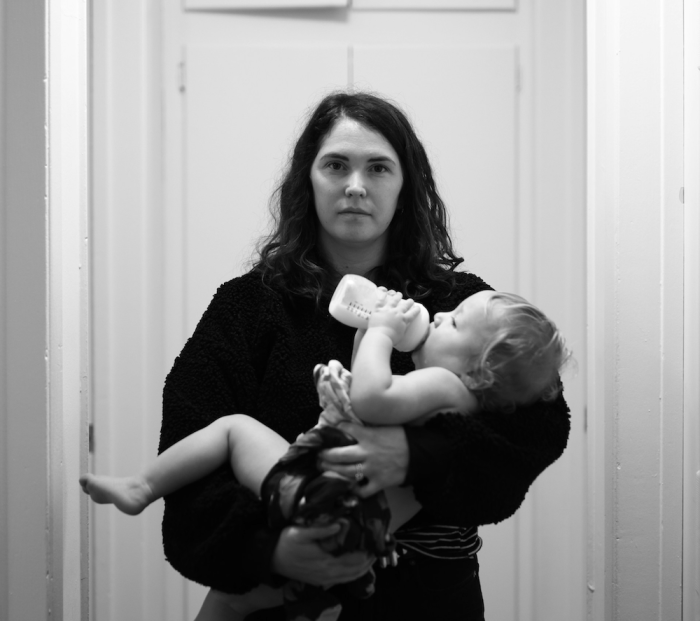
The alarm blares. She’s not waking up—she’s activating.
The to-do list starts running before her feet even hit the floor: breakfast, packed lunches, that one lost shoe, the email to the school. Half a cup of cold coffee (found next to the sock drawer, maybe even from yesterday), and she’s already been up for 40 minutes.
A small hand tugs at her sweater—the socks are itchy today. Another detail to manage.
Meanwhile, across the hallway, he stretches. Scrolls. Breathes. He eventually appears in the kitchen, coffee in hand, and offers a cheery, “Relax, will you?” just as she’s wrangling kids, bags, and muffins for the school play into the car. “See you tonight!” he calls out—as if the morning hadn’t just been a battlefield in her head, and as if the day ahead were evenly shared.
It’s not. And not because he’s a bad partner. He likely has no idea what she’s carrying.
And that’s exactly the problem.
This description isn’t fiction. It comes from my clinical work with couples (identifying details have been changed to protect privacy). It’s drawn from the way many of my clients describe their mornings. The same house. The same kids. Two very different experiences.
And it all comes back to the invisible to-do list.
The Invisible To-Do List
The visible tasks of life—work, parenting, bills, groceries—are the easy ones to name. You can write them on a list. You can divide them between two calendars.
But there’s another layer of work that rarely gets named, let alone divided: the mental load.
It’s the silent hum running in the background of your mind. It’s remembering the birthday party next month. That muffins need to be baked for Sunday’s football match. That your mother-in-law hates lavender, so the last-minute scented candle as a gift won’t do. It’s knowing who likes which cereal, who gets overstimulated at drop-off, who needs the form signed today or the teacher will send another sharp reminder.
This load often settles—silently—on one partner’s shoulders. More often than not, women’s. Not because they’re better at it, or naturally suited for it, but because they’ve been socially trained to notice, remember, and anticipate. And because the other person often doesn’t even see it happening.
But not seeing it doesn’t make it less real. It just makes it lonelier.
“Emotional labor…is the unpaid, invisible work we do to keep those around us comfortable and happy.” ~ Gemma Hartley, Fed Up
What the Research Tells Us
Here’s the part that stings: Research shows that married men tend to be healthier, live longer, and report higher happiness than single men.
Married women, on the other hand, are more likely to report higher stress, lower health, and even shorter lifespans than their single counterparts.
The emotional math isn’t adding up.
Why? Because the “invisible labor” of emotional management, household logistics, and relationship maintenance is exhausting—and when one person shoulders the lion’s share of it, even loving partnerships start to erode their well-being.
According to recent surveys, more than three-quarters (76.4 percent) of unpaid domestic care work worldwide is done by women, compared to just 23.6 percent by men (Charmes, 2019). Even in developed countries, women still shoulder around two-thirds of unpaid domestic labor (65 percent). In developing and emerging economies, the figure rises to over 80 percent. As U.N. Women notes, no country in the world has yet achieved gender parity in the distribution of unpaid care work (U.N. Women, 2019).
Sociologist Allison Daminger explored this in a 2019 study published in American Sociological Review, where she broke down what’s known as cognitive labor—the mental work of anticipating needs, making decisions, and monitoring outcomes. Her research revealed that even in relationships considered “equal,” women were still more likely to carry the mental bulk of family life. Not because their partners were indifferent, but because so many of the tasks are so embedded in daily life that they’ve become invisible.
But invisible doesn’t mean unfelt.
It’s Not About “Helping”
Let’s be clear: It’s not about asking someone to “help with the kids” or “pitch in with the birthday planning.” It’s about sharing the responsibility.
True partnership isn’t one person managing the system and the other following instructions. If you’ve ever said, “You could’ve just told me,” pause and ask instead: Why do they always have to be the one doing the telling?
“Social psychologists have their own name for the mental load. They call it mnemonic work. Studies have established that couples intuitively, rather than consciously and explicitly, divide the work of planning and remembering. And just as intuitively, it mostly falls on wives.” ~ Darcy Lockman, author of All the Rage: Mothers, Fathers, and the Myth of Equal Partnership
“He’ll say, ‘Just tell me what to do.’ But I am so tired I can’t even find the words to explain. If I need to sit down and make him a list, that’s just one more task I don’t have time for. They’re his kids too—how can he not know what they need for football practice after all these years?” ~ Client, 39
How Much Is Too Much?
These stories echo what I see again and again: the exhaustion is cumulative. And it can be measured not only in chores done, but in the energy that gets drained away before love, intimacy, or connection ever have a chance.
Imagine that we all start the day with 100 energy tokens. Now spend:
>> 30 on your actual job
>> 20 on meals, laundry, groceries
>> 15 on planning and coordinating
>> 10 on remembering things for everyone else
>> 15 on managing feelings and transitions
>> 10 on just keeping the system from collapsing
Look down, and the pile is already gone.
And here’s the hidden cost: by the time the practical tokens are spent, there are none left for the things that truly nourish a relationship or yourself. No energy for intimacy or tenderness. None for deep conversations that stimulate your mind and remind you why you chose each other. None for simply being in love and showing love—not just as co-managers of a household, but as partners, friends, and lovers.
“When he notices and acts without asking, my whole body relaxes. It feels like we’re on the same team. I feel seen and taken care of. On days like those, I become my old self again—the one who wants to give him a spontaneous kiss or touch. Because I finally feel seen.” ~ Client, 41
When the mental load consumes everything, the relationship itself becomes another task to manage, instead of the source of joy and connection it’s meant to be.
Is it any wonder so many collapse into bed not with peace, but with a mental scroll of everything still undone? Everything waiting for them tomorrow?
What Can We Do?
Mental load isn’t just a gender issue. It’s a relationship health issue. It’s a family culture issue. And, above all, it’s a question of empathy.
Research confirms what many women already feel in their bones: invisible labor takes a real toll. It drains energy, health, and joy when one partner quietly carries more than their share.
But this isn’t about blame. In fact, many men genuinely want to contribute more—they just haven’t been taught to notice the invisible tasks that keep a household running. Once they do, most are relieved to share the weight rather than add to it.
That’s why awareness matters. A simple question, “What’s something you’re holding in your mind right now that I haven’t noticed?” can be the start of a shift. Not from one person managing and the other helping, but from two people building a partnership where the mental load is shared, respected, and visible.
Because in the end, the goal isn’t to prove who carries more. It’s to create a culture of empathy and teamwork, so both partners have enough energy left for joy, intimacy, and the parts of life that make love worth it.
So…which morning was yours?
Was it the coffee-hunting, sock-finding, mental-juggling whirlwind? Or the slow stretch and scroll?
Both partners matter. But only one of them might be burning out silently.
It’s time we start noticing the quiet weight of the mental load—and sharing it before it silences the love it was meant to protect.
~


 Share on bsky

Read 0 comments and reply