0
 Share on bsky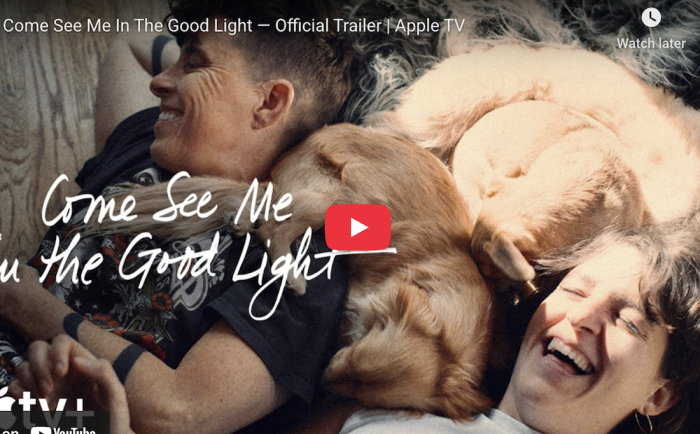
Captivated. Surprised. Amused. Inspired. Uplifted. Open-hearted.
“Come See Me in the Good Light,” the documentary that captures approximately a year in the life of Andrea Gibson, the nonbinary poet laureate facing a terminal cancer diagnosis, and their partner Megan Falley, gave me all the feels.
I think the film changed me. I hope it did. I want it to.
I want it to be a pilot light that keeps burning in and out of my awareness, changing my relationship with death and therefore with life, primed to ignite whatever really matters and sparks joy.
I first became acquainted with Andrea’s poetry a few months ago, specifically on July 15. Scrolling, I happened upon a video of them sitting cross-legged in some green grass on a sunny day with a gentle breeze blowing, reading “Love Letter from the Afterlife” to a lovely woman in a final TV interview.
I was spellbound.
I’ll try not to just keep quoting them and saying, “Isn’t that wonderful?” The words sit differently in black and white silence without the animation of Andrea’s voice anyway. But I will offer just a few of the lines from “Love Letter from the Afterlife” that struck me as particularly poignant:
“You look past me when wondering where I am. It’s okay, I know that to be human is to be far-sighted.”
“I wish you could see the beauty your spirit is right now making of your pain.”
“Dying is the opposite of leaving.”
I was taken not just by Andrea’s poetry but also their arrestingly authentic delivery. They embody a kind of alchemy that melts seemingly contradictory qualities together like soul sisters. Casual and intimate. Vulnerable and brave. Gentle and powerful. Heart-breaking and heart-mending.
A simple, delicate caption to the video read “8/13/75 – 7/14/25.” I did the math. They were seven years younger than me, 49 at that time, just shy of 50.
Then it hit me. July 14 was yesterday. They died yesterday.
I dove into some other videos of their poetry readings, like “MAGA Hat in the Chemo Room.” I wondered how I’d never heard of them.
Searching for some other titles just now, trying to remember which ones I saw that day, I came across “Good Light.” Wow. It is clearly about love, about Megan. I imagined the woman they’d chosen to do that final TV interview with must have been someone they knew and trusted enough with the honor of that experience.
Duh. Now I recognize her as Megan Falley. “Come See Me in the Good Light” is as much her story as it is Andrea’s. I’ve watched it twice. So far.
(A confession about pronouns: I keep catching myself using she/her and switching to they/them. I’ve had to edit some that I didn’t catch. I’m not accustomed to nonbinary pronouns paired with a name like Andrea, which I associate with femaleness. I’m a work-in-progress and Andrea’s story and poetry are still working on me.)
To say they open my heart and mind is absolutely in the right order—but putting it far too meekly. They crack my heart open. My mind follows along like a puppy with complete trust in the benevolence of its master. Something rearranges inside me as I listen. My mind quiets. My heart becomes energized and receptive. To an overthinker, that is one hell of a gift.
It must be appreciation leaking out of my eyes.
Stretching my understanding of gender is only one sliver of the film’s impact, but I’ll start there. When Megan told a story about something they did on a dance floor when they were first dating, my mind registered they as plural and I imagined some other friend dancing with them. I caught my mistake on the second viewing and felt silly. They meant Andrea.
Andrea talks about being mispronouned. (Note: spellcheck didn’t recognize that word; spellcheck can learn too.) They noticed they were much less reactive about it after the cancer diagnosis compared to before. They explained it was as if identity, including gender, “fell off” as they felt more in tune with the part of them that’s eternal. They were careful to express that in a way that reflected obvious respect and caring for the challenges their nonbinary friends were still facing and feeling.
Part of the film’s charm lies in the humor. Andrea and Megan both exhibit an endearing balance of lightness with the heaviness of the journey they’re on. I’ve often thought good humor has a quality of recognition and surprise. We see ourselves in the things that make us laugh in ways we didn’t consciously know until the moment the laughter escapes, thus the surprise.
I’m going to coin a phrase, with an appreciative nod to Andrea and Megan, who inspired me to make it up: Namaste laughter. The light in me is laughing with the light in you, exposing my heart that’s known all along how interconnected we all are—even though my mind keeps forgetting.
One of my favorite examples of that kind of humor are Andrea’s words, half laughing as they’re spoken: “Dying would be a lot easier if everyone died at the same time!” Dang, they’re not wrong. I think it’s the part of me that wants life to make sense, that can hang out in the bargaining stage of grieving any loss like a boxer in a ring holding onto their opponent for dear life, that makes that funny-but-not-funny sentiment so relatable. Right on.
Losses would be so much easier if we were all ready to let go at the same time.
Next, they reconsider the upside of being the one who dies first. Their friends will get to be “more of who they are.” They expressed it so calmly that I almost missed how loving that sentiment was. I don’t doubt Megan is becoming more of who she is now. I saw a clip of an interview with Anderson Cooper in which her carefully chosen language about how Andrea “allegedly died” moved him to tears as she calmly asserted that none of us really knows what happens.
I’m tempted to say every other part of the film was my favorite, and tell you all about why, but I don’t want to give too much away. I’ll just encourage you to watch it. You won’t regret it.
You might even have a strong urge to watch it again so you can process all the feelings it stirs up. You might want a second chance to pick up gems of wisdom and put them in your pocket like mementos from a visit to a beautiful place when you have to leave it.
So, I’ll bring this love letter to “Come See Me in the Good Light” to a close with three specific things I loved from the beginning, the end, and the in-between:
“Death Anthem,” the working title for the first poem we hear becomes “Life Anthem” in its final form. That might be the whole point, but you need to go on the journey to really get it.
“Stay with me y’all because my story is about happiness being easier to find once we realize we don’t have forever to find it.”
The film closes with a song, “Salt Then Sour Then Sweet.” The emotionally evocative voices of Sara Bareilles and Brandi Carlile sing a duet of lyrics adapted from one of Andrea’s poems. All. The. Feels.
The gem I most wanted to put in my pocket and carry from the film into my life were some words of comfort Andrea offered a friend who was full of angst as her father was having a serious medical emergency:
“Everything that you’re feeling now, name it love.”
So simple. So transformative. We can choose to look through the eyes of love instead of fear. I’ve been practicing that.
I was anxious about preparing a Thanksgiving meal I could serve a family member whose dysphagia from a stroke carries a risk of aspiration. Naming that love softened the whole process to a more creative one of substituting foods he could enjoy that minimized the risk.
As my kids are growing through and beyond their teens, responding differently to me than they used to, I worry I’m losing them, but I can name that love too. That’s my best shot at honoring the growth unfolding for all of us and participating in it instead of getting in the way.
Spoiler alert, I think the good light is love.
If you’re at all like me, you might need a little help in matters of love—giving or receiving or believing in it. Or maybe you could use some uplifting in matters of life and death. “Come See Me in the Good Light” more than delivers.
See and feel it for yourself.
~


Read 2 comments and reply