0
 Share on bsky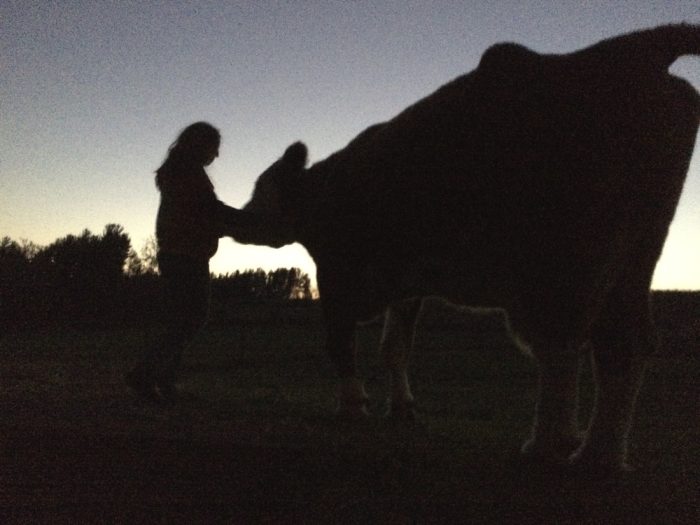
The sacred enters quietly.
Sometimes it arrives in a barn, in the warm breath of a cow whose life you feared you were about to lose.
Penny was leaning her massive head against my chest, her body burning with fever, her eyes rolling back as mastitis overwhelmed her. All I could do was hold her and pray.
Time dissolved. Even the birds fell silent. And then, in the stillness, Penny inhaled deeply, her eyes focused on mine, and she whispered a sound I knew meant “thirsty.”
In that moment, something holy moved through the room.
My earliest understanding of God came from moments like this—not from scriptures. I grew up in a home shaped by the trauma of war and displacement. My father fled the violence of the Partition of India. My mother survived the Nazi occupation of the Netherlands. Their wounds were real and unspoken, and the air of my childhood held their grief like weather.
Who I trusted most was Panda, the dog who became my first teacher of love. She protected me, soothed me, and offered a steady tenderness that felt like a doorway to something larger and more merciful than anything human.
Long before I knew the names for such things, before I learned prayers in Sanskrit or understood the teachings of the Divine Mother, I knew the presence of something sacred because Panda embodied it. Her watchful eyes, her quiet warmth, and her unconditional acceptance were my first experience of grace.
Later, when I began rescuing animals and eventually founded Indraloka Animal Sanctuary, I recognized those same qualities again and again. The Hindu teachings I was raised with finally made sense when I saw them alive in animals. The Divine Mother is said to protect, nurture, and stand fiercely for the vulnerable.
I saw that most clearly in Penny, the elderly cow who had lost every calf she ever bore on a beef farm. When she met Mookie, a starving orphaned calf, her tears fell freely, and her udders filled with milk for the first time in seven years as her compassion caused spontaneous lactation. Her love was instinctive, selfless, and vast. It felt like witnessing the maternal face of God.
Animals practice a form of devotion without ever performing it. They do not recite prayers, yet they embody prayer. A horse standing in the sun with his head lowered, breathing deeply as his nervous system settles, is practicing presence. A pig who leans into your hand after months of fear is practicing surrender. A flock gathered around a frightened newcomer is practicing compassion.
Their lives are liturgies.
Their breath is a mantra.
Their trust is a sacred offering.
At the sanctuary, I often think of the barns as temples and the pastures as an ashram. The animals chant with their bodies. When a traumatized being arrives, every creature around them seems to know. The horses watch over them. The cows breathe more slowly. The birds quiet down. Healing is communal, and no one rushes the process. It is an embodied kind of worship, one that teaches me more about humility than any book ever has.
Caring for dying animals has deepened that understanding. In their final hours, many become peaceful in ways that defy explanation. They teach acceptance without preaching it. Their bodies soften. Their breathing slows. Their eyes find you with a clarity untouched by fear.
They remind me that impermanence is not a punishment. It is a transition, a return, a release.
Each time I sit with an animal as they cross that threshold, I feel the veil thin. This too feels like God. Again and again, the animals teach that God is not something we achieve through striving or purity. God is something we learn to receive. The Sacred arrives in moments of connection, in breath, in the simple act of being fully present with another being. The Divine reveals itself through relationship, through tenderness, through shared vulnerability.
I have bowed to God many times in temples. But the deepest bows of my life have been in barns, with my forehead resting against the warm flank of a cow. In those moments, there is no separation between the sacred and the ordinary. There is only breath, and love, and a presence that feels infinite.
Animals remind me that the holy is not rare. It is everywhere. It pours through the world in hoofbeats and feathers, in soft noses and trembling bodies learning to trust again. It lives in the way we care for one another. It lives in the grace we offer. It lives whenever we choose compassion over fear.
I often end my days with a prayer, one I whisper quietly as I close the barn doors for the night:
सर्वे भवन्तु सुखिनः
May all beings be happy.
May all beings be safe.
May all beings know peace.
It is a prayer the animals teach me a little more fully each day.
~
author: Indra Lahiri, PhD
Image: Courtesy of Johnny Braz for Indraloka Animal Sanctuary
Editor: Nicole Cameron

Read 1 comment and reply